Hands On
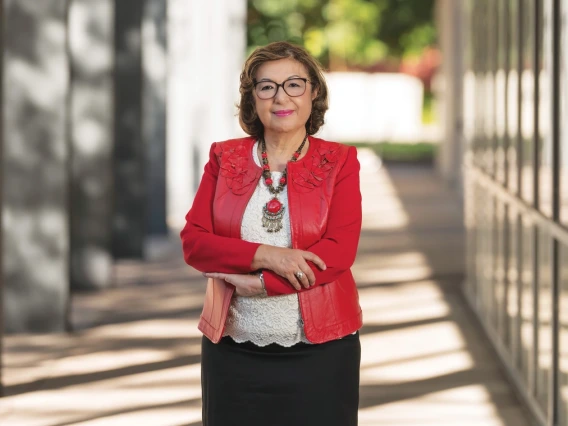
Terry Seligman ’67 is helping the library expand its technological horizons through experiential learning opportunities at CATalyst Studios.

As an undergrad coming from San Francisco (her brother was already here on a golf scholarship), Terry Seligman ’67 double majored in French and Spanish, with an emphasis on 20th century literature. She loved reading, loved languages, loved libraries and books and travel and art. Then, as it sometimes does, professional life put her on another track. “I went to work for IBM,” she says. “They recycled me and made me a businesswoman.”

Seligman eventually reconciled her work with her passions, starting a business that offered custom art and architecture tours in North America and Western Europe for museum groups. “I’d go to middle-sized museums that weren’t big enough to have their own in-house travel person, and I’d be that person,” she says; she later started a travel insurance brokerage that she says went “hand in glove” with the tours.
Seligman was intrigued: Here was a place where students could not only access new knowledge (the classic ideal of a library) but also put that knowledge to direct, immediate use, maybe even bring products to market.

She’d been supporting libraries at the U of A for about a decade, both as a donor and as a member of the library’s advisory board, when she learned about CATalyst Studios. A collection of workspaces housed inside the Main Library and completed as part of the Student Success District in 2022, CATalyst includes a sound studio, green screen room, a virtual reality studio and a maker studio where students can receive certification in using laser cutters, 3D printers and other digital design and fabrication tools, as well as more familiar tools like sewing machines. (The Student Success district also includes innovative renovations to existing spaces like Main Library and Bear Down Gym as well as new buildings like the Bartlett Academic Success Center; all of CATalyst is open to the public.)
Seligman was intrigued: Here was a place where students could not only access new knowledge (the classic ideal of a library) but also put that knowledge to direct, immediate use, maybe even bring products to market.

The sticker logo Seligman created at CATAlyst Studios.
“I was an entrepreneur. I started and built three small businesses — very small, but successful,” she says. “The more I heard about CATalyst, the more I thought it would be a good thing for me to support, because I like what it’s doing.”
Seligman chose to make an endowed gift. Digital Design and Fabrication Specialist Niko Sanchez says Seligman’s gift is helping CATalyst keep pace in a rapidly changing technological landscape. Just recently, for example, the studio was able to update its VR headsets to Meta Quest 3s, which Sanchez used in a demonstration of plein air painting outside Old Main, taking images with the headset and projecting them onto the canvas as a guide. (The VR studio is named after Seligman, too.)
Sanchez, who is also a doctoral student in the Applied Intercultural Arts Research Program, personifies the kind of experiential learning opportunities CATalyst offers. “I come from a fabrication and art background, but also a science background,” he says; prior to coming to the U of A four years ago, he taught biotechnology and precision machining at Tucson High School.

Terry Seligman
“The first time [Terry] came in, I wanted to make sure that we had made something that was from the space, and from a student perspective,” Sanchez says. “So I worked with a student to make her a pair of earrings on our little CNC machine. We totally vibed. Every time we see her, it’s just like — ‘Gosh, Terry, it’s so good to see you.’”
Seligman eventually took a turn at the studio herself. “I love to bake, OK?” she says. “And when I give away my baking, I have baker’s boxes, and I have a logo, which is a drawing of my face.” Sanchez helped Seligman design and print a sticker with that logo to make her baked-goods boxes just a little more personal.
“Am I a technical wizard?” she says. “Nope!” But she’s out there making use of the tools in the shed — and isn’t that the idea?
“I was an entrepreneur. I started and built three small businesses — very small, but successful,” she says. “The more I heard about CATalyst, the more I thought it would be a good thing for me to support, because I like what it’s doing.”