One Gift, Two Perspectives
Dean Carmala Garzione and donor and alum Sarah Smallhouse reflect on a spectacular gift to the College of Science.

Last year, Sarah Smallhouse ’88 ’15 made a gift of $5 million to create the Sarah Brown Smallhouse Endowed Deanship at the University of Arizona College of Science. As the daughter of Thomas R. Brown, Smallhouse is part of a storied history of giving through the Thomas R. Brown Foundations — integral to wide-ranging philanthropy that has had significant impacts across campus.
Endowing the deanship for the College of Science, however, was an entirely personal choice. We sat down separately with Dean Carmala “Carmie” Garzione ’96 ’00 and Sarah Smallhouse to discuss the importance of endowed deanships as well as the passion behind this specific gift and the considerable impact it has on the College of Science.

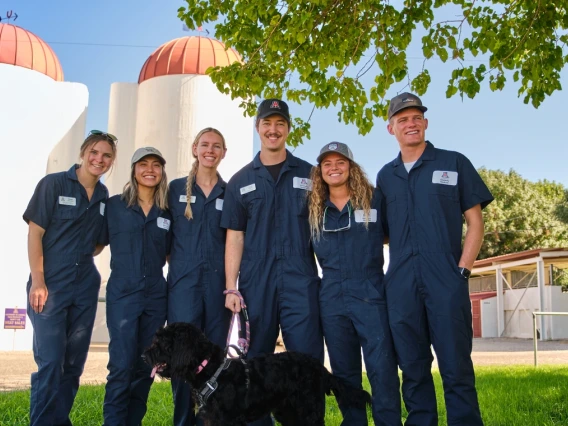
Dean Carmala Garzione and donor and alum Sarah Smallhouse.
Meeting Challenges, Identifying Opportunities: Dean Garzione
Why are endowed deanships important?
They add permanent and flexible annual financial support that enables the dean to be strategic. For example, this endowment will allow me to invest in programs that help our faculty pivot to emerging research funding opportunities so that we can recover more quickly from current federal funding changes. Endowed deanships are also valuable because they stay with the college for future deans, so it gives the university an opportunity to recruit outstanding leadership for the college. Future challenges and opportunities for the College of Science may be different than from today; having the endowment pay out for each future dean will enable them to pursue impactful priorities to navigate the changing times of higher education.
What does Sarah Smallhouse’s gift to endow the deanship for the College of Science mean for the College of Science and for you?
Having an endowed deanship is a wonderful way to support the mission of the College of Science. We all know that the cost of higher education has increased over time. Having unrestricted endowment dollars to be able to deploy for student support in the form of scholarships is incredibly important for our students and their families. Some of the endowment support will also support our faculty in adapting their research to new research funding opportunities.
It is also really meaningful to me that this chair bears the name of a prominent female leader in Southern Arizona who has been an advocate for science and scientifically informed policy. Sarah Smallhouse has been an impactful civic leader and champion for STEM research and education in our region, and so it’s an honor to hold a deanship named after her.
Could you discuss some of the specific impacts this endowed deanship will have? In what ways will it support scholarships and faculty research?
We currently do not have a college-level recruiting scholarship. The College of Science will work with enrollment management to identify strong students who may still need scholarships to close a gap. We’ll probably be able to fund about five new students per year and up to 20 students at a time.
For new faculty, it’s a scary time to start their research careers. Grants are critical for faculty research and for support of graduate students. With shifting priorities in federal funding for research, we plan to dedicate support to junior faculty who are working on getting their first significant grant. This pilot funding will enable them to collect data and perhaps support a graduate student to increase their competitiveness for a range of funding opportunities. Getting college-level support could be a valuable stepping stone for getting later grants.
Can you talk about your relationship with Sarah Smallhouse?
When I started as dean in 2021, Sarah was on the College of Science advisory board, and she immediately stood out as one of the most enthusiastic supporters of STEM, but also of science in general. She recognizes the power of discovery in inspiring people, but she also recognizes the power of discovery in being a force for positive change. She, herself, has a demonstrated track record of deploying science for the benefit of society.
For example, she has been a very strong proponent for the management of buffelgrass, which is an invasive grass in this region that is devastating to our desert ecosystem and has increased fire hazards. She worked with the knowledge of the science behind the management of buffelgrass to raise awareness across the state and to develop programs for better management of this invasive grass. She also shares understanding of how our Laboratory of Tree-Ring Research has helped document historical climate and rainfall records in the Colorado River Basin, which is helping us understand how rainfall and snowfall across this region are impacting current water availability.
Sarah is warm, engaging and deeply curious.
I always enjoy hearing her talk about the things she’s learned or the impact of the work she sees happening in the College of Science and at the University of Arizona. She is a strong advocate for the university and shares stories about the people who are working here, and the students who are studying here, and their motivation to improve the world around us. The word “cheerleader” doesn’t do her justice. She’s an incredible communicator and advocate for the value of the University of Arizona to Tucson, the state of Arizona, and well beyond.
A Moral Responsibility: Sarah Smallhouse
What do you think makes the University of Arizona special?
It’s an AAU university. It’s a Research One university. It’s a land-grant university. It has two medical schools. It’s quite an impressive institution. And our faculty here are globally recognized. It also has benefits like the Flandrau Planetarium and the Mount Lemmon SkyCenter. We have such a jewel sitting right in the middle of our community. The more you learn, the more enthusiastic you get about it.
What drew you to the College of Science? And why are you passionate about its mission?
What drew me to the College of Science was [former dean] Joaquin Ruiz. He asked if I wanted to join the advisory board — and if Joaquin wanted me, I would contribute what I could.
And like I said, the more you learn, the more people you meet, the more labs you visit, it dawns on you how spectacular things are at the College of Science. I mean, think about the Richard F. Caris Mirror Lab. We make mirrors for high-powered telescopes across the world. Why? Because we had a scientist who did something the Defense Advanced Research Projects Agency said couldn’t be done. Or the Laboratory of Tree-Ring Research. We’ve reconstructed the flow in the Colorado River using tree rings. We have rewritten prehistoric history because we can now determine things using tree rings that were only suppositions before.
It just goes on and on and on. And when you get exposed to that, you start to feel that moral sense of, “I’ve got to do whatever I can to help these people.” Or you meet the students. And you see people who are so smart and they don’t mind working hard and they just have so much curiosity, and they want to be a part of it all. It is very inspiring. And there you are. That’s it. You just want to do whatever it is that you might be able to contribute to help them accomplish what they’re trying to do.
What are you excited about regarding this gift? What would you like to see the endowed deanship make possible for the College of Science?
Well, I mean, the whole reason for endowing a deanship is that the answer to that question l view of where the highest and best use of very precious resources is.
But, right this moment, today, I know students are under tremendous financial strain. And so I applaud her directing resources that way.
And then there is research. I was pretty close to despair when I saw the guillotine of federal funding cuts come down on the hard work and the advancements researchers have made. In some cases, it negated work that had been going on for years. And you can’t backfill federal grants. If the dean had just a little bit of capacity to strategically deploy for research, that could be so valuable.
Also, when it comes to recruiting top-flight faculty, offering a little extra money to help someone set up their lab when they come — things like that can be make or break.
Could you talk about your relationship with Dean Garzione?
Well, she’s been working really hard. She has been focused. I think she has done a tremendous job of looking out for the students and handling the faculty and the departments in a way that everyone feels respected and heard.
The other thing that she’s done is really thoughtfully composed the Board of Advisors. We have an excellent Board of Advisors, and it’s Carmi’s doing; Carmi has just been very thoughtful and deliberate and methodical.
I think she’s doing a great job. I really like to surround myself with people who are smarter and more capable — funnier, you know. And she’s all those things.
There are so many worthy causes you could support. Why did you decide to endow a deanship for the College of Science?
I wanted to make gifts this year for personal reasons, and I reached out to Cheryl Tomoeda, who is the assistant dean for alumni and development, to ask for a reminder of the COS’s top priorities. Without hesitation, she said, the first priority is endowing the dean.
And I thought, if there’s one thing that I would like to do for me, not the [Thomas R. Brown] foundation, it would be something big in science. And I can’t go pay for the telescope in Chile — I mean, there’s a limit. This was about as big a bite as I felt I could take. But I thought it really could be enduring and impactful. And I decided now is a really good time to do this, and I should do this.
Why did I do it? Money’s no good unless you do something with it. So there were personal reasons, circumstantial things, my exposure to the college, the fact that this was the top priority, the fact that I have had relationships with deans and I see what kind of decisions they have to make and the challenges they face. All of it came together to make it, oddly, an easy decision.