Taking the Long View
Engineering meets business thanks to a $10 million commitment to support workforce development, providing students with a shift in perspective.

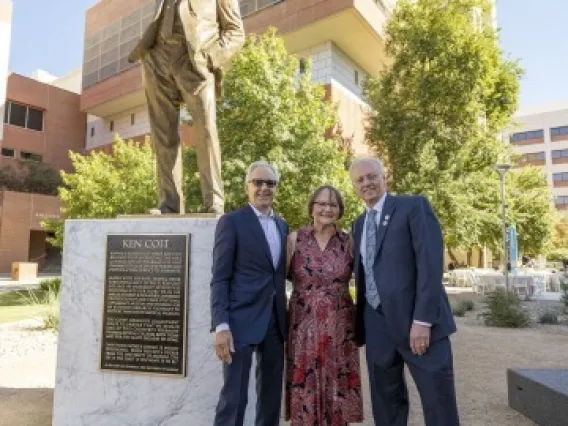
From left: Karthik Kannan, dean of the Eller College of Management and holder of the Halle Chair in Leadership; John-Paul Roczniak, president and CEO of the University of Arizona Foundation; Felipe M. Rodriguez; Mary Rodriguez; Sen. Mark Kelly; Gov. Katie Hobbs; Kimberly L. Ogden, Craig M. Berge Interim Dean, College of Engineering; University of Arizona President Suresh Garimella; and Barbara Borgonovi, president of Naval Power at Raytheon.
For decades, engineering and business students at the University of Arizona have moved through parallel but separate worlds — different buildings, different curricula, rarely speaking the same language. That’s about to change. Thanks to a transformative
$10 million gift from Mary and Felipe M. Rodriguez, the U of A has launched the Integrated Business and Engineering Program, a four-year pathway merging business with engineering to produce graduates fluent in both disciplines.
The program formally became the Mary and Felipe M. Rodriguez Integrated Business and Engineering Program in recognition of the couple’s commitment to workforce development, engineering education and student opportunity.
Felipe Rodriguez founded Aeronautical Systems Incorporated in Washington, D.C., in 1988 and continues as the company’s CEO. Mary Barrett Rodriguez joined ASI in 1993 following many years of teaching in London and California. She is responsible for the company’s charitable giving program, which supports local educational initiatives with a focus on engineering and technical education. Together, the Rodriguezes have used their philanthropy to help universities improve and expand their engineering and technical science programs.
“Every great leap in human history happens at an intersection,” the Rodriguezes said. “Throughout our careers in aerospace engineering, we have seen incredible technical ideas die in labs because no one knew how to build a business around them, and brilliant business strategies fail because they lacked technical depth. We see this gift as a partnership to build a bridge between two brilliant colleges, forging a new kind of leader who speaks both languages fluently. To us, this philanthropy is an act of ‘radical trust’ in the future — investing in the magic that happens in between business and engineering.”
Mike Kwinn ’94, IBE’s director, is a West Point graduate who spent 25 years in the Army, much of it teaching at his alma mater. He also received a master’s degree from the University of Arizona in systems engineering. His path spanned the Pentagon, deployments to Korea, Iraq and Afghanistan, and six years at Raytheon.
The idea for IBE grew directly out of what industry leaders have been saying for years, he says. “When I was going to school, they said, ‘OK, engineers, you’re on one side; business people, you’re on the other side,’” Kwinn recalls.
“Now we’re getting input from industry saying, ‘If I don’t have somebody that understands both of these things, they are not valuable to me.’”
The Rodriguezes’ own experiences helped shaped the program’s vision. Their business depends on people who can move fluidly between engineering execution and business strategy — and they see the U of A as an opportunity to build that pipeline, not just for their own company, but for the broader industry.
The IBE program is housed in the Eller College’s McGuire Center for Entrepreneurship. Its curriculum is structured around three pillars: an engineering foundation of core math and science courses; a business foundation covering finance, economics and business planning; and — at the heart of it all — a project pillar in each semester for all four years. First year students start with an introductory project. Second year students will partner with local nonprofits on real needs like water delivery systems or low-income housing design. Third year students will focus on leadership, ethics and working directly with industry professionals. In their final year, students will take on a yearlong capstone: designing a technological solution and building a full business plan around it, with the goal that some may graduate ready to launch their own companies.
“Our benefactors’ imperative is that these students be industry-ready,” Kwinn says. “That means understanding deadlines, working with customers and delivering on what they promise.”
The new program has already caught industry’s attention. “We’ve got people in industry already asking about internships, already asking about hiring,” Kwinn notes.
IBE’s first cohort began in the fall, with plans to grow toward classes of 100 to 200 students in the years ahead. Decades from now, the startups and transformational companies born from this program are expected to create jobs and solutions that don’t yet exist, serving as a spark for future innovations.